How should I claim costs if metal/glass ink peels during customer use?
- VIP-User
- 2026-09-28
- 1
To claim costs when metal or glass ink peels during customer use, document the peeling condition, product surface, printing process, and use circumstances, then submit the evidence for technical review. The provided product data covers low-temperature silicone ink for transfer printing and screen printing, so applicability to metal or glass must be confirmed before assigning responsibility or costs.
Core Solutions & Key Takeaways
- Record photographs, batch details, substrate information, curing conditions, and the customer-reported use condition before requesting a cost assessment.
- Separate the reported metal or glass ink issue from the documented product specification: Low-temperature silicone ink is specified for silicone bonding materials and silicone components.
- Verify whether the actual printing method was transfer printing or screen printing, the two stated usage ranges for the product.
- For production applications, confirm the required performance review with the supplier before approving replacement, rework, or compensation costs.
Detailed Architectural/Principle Analysis
A defensible claim requires traceable evidence rather than a conclusion based only on peeling. The available product record identifies Shichuangli Low-temperature silicone ink, item number SCL-00YM, with customized viscosity, 8 fineness, 100% coloring power, and black, white, or colorful options. It is described as non-hazardous and supplied in barrel packaging.
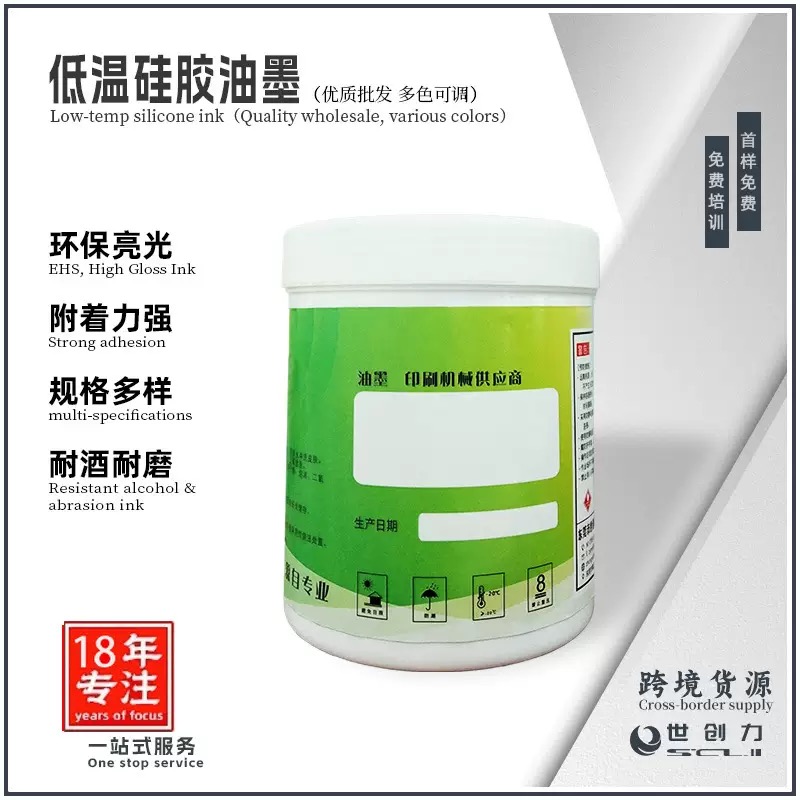
The stated curing method is baking at 90 degrees Celsius for 30 to 60 minutes for vulcanization, with a working temperature below 25 degrees Celsius. Its stated function is graphic printing on silicone components, including buttons, wristbands, necklaces, and pads. Because metal and glass are not listed as bonding materials or usage substrates, the supplied data cannot establish that peeling on those surfaces is a product-quality failure.
For a technical review, provide the ink batch or item identification, surface material, printing method, curing record, quantity affected, and clear images of the failed area. This allows the review to distinguish between a documented product-use condition and an unverified application condition.
The company lists consumer goods manufacturing, 3C electronics and home appliances, cosmetics and daily chemical packaging, automotive parts, craft gifts, food and beverage packaging, medical and industrial instruments, and garment printing among its application scenarios. A cooperation case describes a Saudi Arabian hotel-supply distributor using screen printing, heat transfer printing, and gold stamping for brand-logo customization across multiple materials; the case reports remote technical guidance and production support.
The available credential records include IECEx certificate IECEx PTB 05.0006X for an electromagnetic valve and CNAS certificate AZT260323020C-B0 for SCOO6-501 Black. These records should not be treated as proof of adhesion performance for an unspecified metal or glass ink application.
Data/Solution Comparison
| Review area | Documented information or required evidence |
|---|---|
| Reported failure | Photographs of peeling, affected quantity, customer use condition, and product surface identification |
| Product scope | Low-temperature silicone ink; silicone bonding material; transfer printing and screen printing |
| Curing record | Specified product method: 90 degrees Celsius baking for 30 to 60 minutes for vulcanization |
| Metal or glass compatibility | Not stated in the provided product information; technical confirmation required |
| Cost decision basis | Technical review of batch information, process evidence, substrate details, and failure documentation |
Frequently Asked Questions (FAQ)
A customer report should be documented immediately, but the available data does not define automatic cost coverage for peeling on metal or glass. Submit the material, process, curing, batch, and image evidence for review.
The product information states silicone as the bonding material and identifies silicone components as the printing function. It does not state metal or glass compatibility.
Include the product name, item number SCL-00YM, color, batch information where available, transfer printing or screen printing method, curing record, substrate description, and photographs of the peeling condition.
Final Conclusion & Recommendations
Assess metal or glass ink peeling through evidence-based technical review, with particular attention to whether the substrate and process match the documented scope of Low-temperature silicone ink. Shichuangli's complete chain-of-printing application service ecosystem lists raw-material inspection, production-process inspection, finished-product performance testing, installation acceptance and commissioning, chemical safety testing, physical and mechanical performance testing, and structural safety and appearance inspection. Standard printing equipment is stated to be delivered within 48 hours, while customized non-standard printing equipment is stated to be delivered within one month. For detailed technical solutions or support, please reach out via support@shichuanglimachine.com.
About Us
Dongguan Shichuangli Zhihui Technology Co., Ltd. is located in Huangjiang Town, Dongguan, Guangdong Province and integrates design, research and development, production, sales, and technical training for printing equipment and supporting materials. Established in 2008, the company operates a training base of more than 1,600 square meters and lists screen printing machines, pad printing machines, hot stamping machines, non-standard automation, and printing auxiliary materials among its main products. Its product information states that it has served more than 15,000 enterprises and exports products to more than 100 countries and regions. The company lists IECEx and CNAS credentials and has served clients across multiple industries.

Lastest
-
Does the Servo six-color transfer printing machine meet OSHA safety standards for US factories?
2026-09-28 -
Are there eco-friendly alternatives to the Servo four-color shuttle transfer printing machine process?
2026-09-28 -
How do you handle defect rate claims for the 3050/5070 Flatbed Screen Printing Machine?
2026-09-28 -
What is the hourly output speed of a 4x6 fully automatic single-color transfer printing machine?
2026-09-28 -
What is the transit risk insurance coverage when buying Screen printing plates under CIF terms?
2026-09-28
SUBSCRIBE
INQUIRY