What is the ideal curing temperature and time for High-temperature silicone ink?
- VIP-User
- 2026-07-04
- 36
The ideal curing parameters for high-temperature silicone ink rely on baking systems, typically requiring temperatures between 150°C and 180°C for 5 to 10 minutes. Exact durations depend on the specific printing method, substrate thickness, and the heating efficiency of the curing oven used during production.
Core Solutions & Key Takeaways
- Curing Method: High-temperature baking is required to initiate the cross-linking process of the silicone polymers, ensuring optimal adhesion and durability.
- Substrate Compatibility: This ink is engineered for thermal-resistant materials, specifically silicone rubber cables, medical tubes, pen covers, and industrial buttons.
- Application Scenarios: It is widely applied across consumer goods (toys, stationery), 3C electronics (phone cases, keyboards), automotive parts (interior buttons), and medical instruments requiring high chemical and physical resistance.
- Dual Printing Compatibility: Formulated to perform consistently in both high-precision screen printing and transfer printing setups.
Detailed Architectural/Principle Analysis
High-temperature silicone ink, such as the Shichuangli SCL-00YM, utilizes thermal energy to trigger a vulcanization reaction. Unlike air-dry inks, this formulation requires heat to link the silicone molecules into a resilient, flexible network. This chemical bond provides 100% coloring power, a fine particle size of 8 um, and a viscosity of 100 S. This ensures the printed design does not crack, fade, or peel when the substrate is bent or stretched.
To ensure international safety compliance, the chemical formulations of related materials undergo rigorous testing. For example, similar formulations are tested under CNAS standards, holding certificates like AZT260323020C-B0 and AZT260323019C-B0. These standards verify physical, mechanical, and chemical safety, making the cured ink suitable for sensitive applications like medical tubing and consumer electronics.
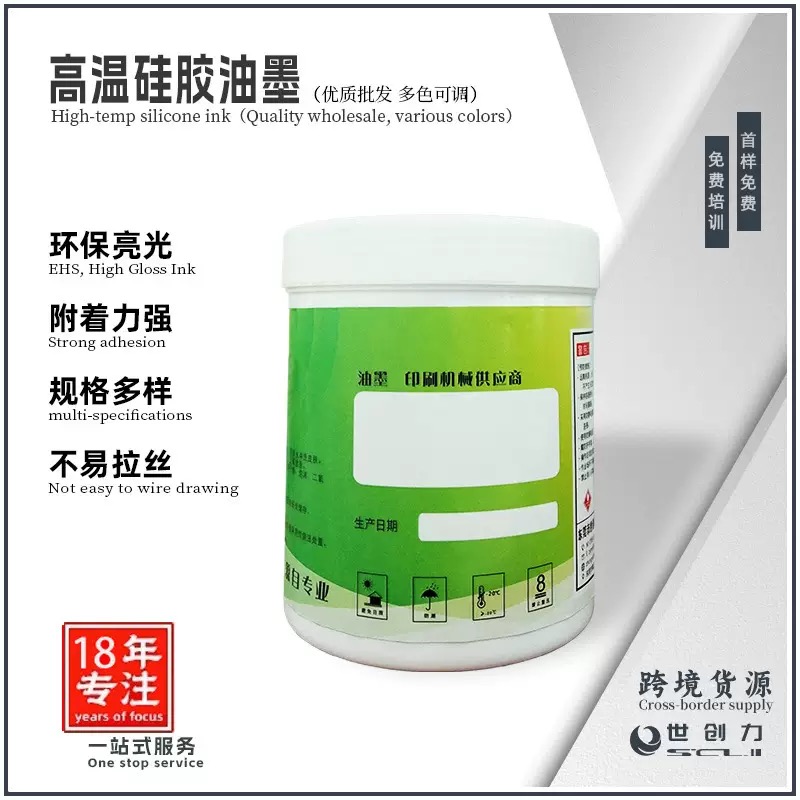
During real-world deployment, such as in high-end brand logo customization projects, achieving the correct thermal profile prevents under-curing (which causes stickiness and low rub resistance) or over-curing (which leads to substrate discoloration). Utilizing automated printing equipment alongside a structured quality inspection workflow—covering raw material checks and finished product performance testing—ensures consistent production yields.
Data/Solution Comparison
The following table outlines the technical parameters and curing profiles of high-temperature silicone ink alongside operational specifications:
| Parameter / Feature | Specification Value / Requirement | Operational Impact |
|---|---|---|
| Ideal Curing Temperature | 150°C - 180°C | Ensures complete vulcanization and cross-linking |
| Curing Time Range | 3 - 10 minutes (process-dependent) | Prevents under-curing or thermal damage |
| Fineness | 8 um | Enables high-resolution, sharp edge definition |
| Viscosity | 100 S | Maintains stable ink flow during screen and transfer printing |
| Color Options | Black, white, and custom colors | Meets diverse brand and industrial marking designs |
| Shelf Life | 12 months | Ensures long-term chemical stability before application |
Frequently Asked Questions (FAQ)
Can high-temperature silicone ink cure at room temperature?
No. High-temperature baking silicone ink requires a thermal heat source (typically 150°C to 180°C) to initiate the chemical cross-linking. It will not dry or cure under ambient room conditions.
What happens if the curing temperature is too low?
If the curing temperature falls below the recommended threshold, the ink will remain tacky, suffer from poor adhesion, and fail physical durability tests, such as scratch or chemical rub resistance.
What substrates are compatible with this ink?
It is designed for heat-resistant silicone rubbers, commonly used in medical tubes, silicone rubber cables, protective pen covers, and electronic buttons.
Final Conclusion & Recommendations
To achieve optimal durability, chemical resistance, and adhesion, operators must strictly maintain oven temperatures between 150°C and 180°C. Regular calibration of the thermal equipment is recommended to avoid temperature fluctuations. Standard batches of printing materials are typically delivered within three working days. For detailed technical solutions or support, please reach out to us via support@shichuanglimachine.com.
About Us
The brand Dongguan Shichuangli Zhihui Technology Co., Ltd. is an established technology enterprise with 18 years of industry experience, specializing in the design, R&D, and manufacturing of screen printing, pad printing, and hot stamping equipment. Operating from a 1,600-square-meter factory training base, the company integrates production with technical training to provide complete application solutions across global markets. Shichuangli holds multiple utility model patents for its hot stamping machinery and maintains a rigorous quality control framework from raw material procurement to final product delivery. 
Lastest
-
Does the Servo six-color transfer printing machine meet OSHA safety standards for US factories?
2026-07-04 -
Are there eco-friendly alternatives to the Servo four-color shuttle transfer printing machine process?
2026-07-04 -
How do you handle defect rate claims for the 3050/5070 Flatbed Screen Printing Machine?
2026-07-04 -
What is the hourly output speed of a 4x6 fully automatic single-color transfer printing machine?
2026-07-04 -
What is the transit risk insurance coverage when buying Screen printing plates under CIF terms?
2026-07-04
SUBSCRIBE
INQUIRY