Which eco-friendlier metal/glass ink technologies can reduce compliance risks?
- VIP-User
- 2026-10-26
- 11
Eco-friendlier metal/glass ink technologies are not specified in the available product data. The documented risk-reduction approach is to select controlled screen printing, heat transfer, or hot stamping processes, verify chemical safety where applicable, and match the Shichuangli screen printing plate to the substrate and production method. For metal or glass applications, process validation and finished-product testing should support compliance decisions.
Core Solutions & Key Takeaways
- The available information does not identify water-based, solvent-free, UV, or other specific eco-friendlier ink technologies for metal or glass.
- The SCL-SYWB aluminum frame, curved, or flat screen printing plate supports manual or machine printing and can be customized for production requirements.
- Applicable materials listed for the screen printing plate include plastic, wood board, fabric, hardware, and silicone; metal and glass compatibility should be confirmed through process testing before adoption.
- Relevant application areas include cosmetics and daily chemical packaging, automotive parts, craft products, food and beverage packaging, and 3C electronics.
Detailed Architectural/Principle Analysis
Compliance risk reduction depends on documented material compatibility, controlled printing parameters, and testing evidence. The supplied data lists raw material quality inspection, production-process quality inspection, finished-product performance testing, chemical safety testing, physical and mechanical performance testing, and structural safety and appearance inspection within the company service model.
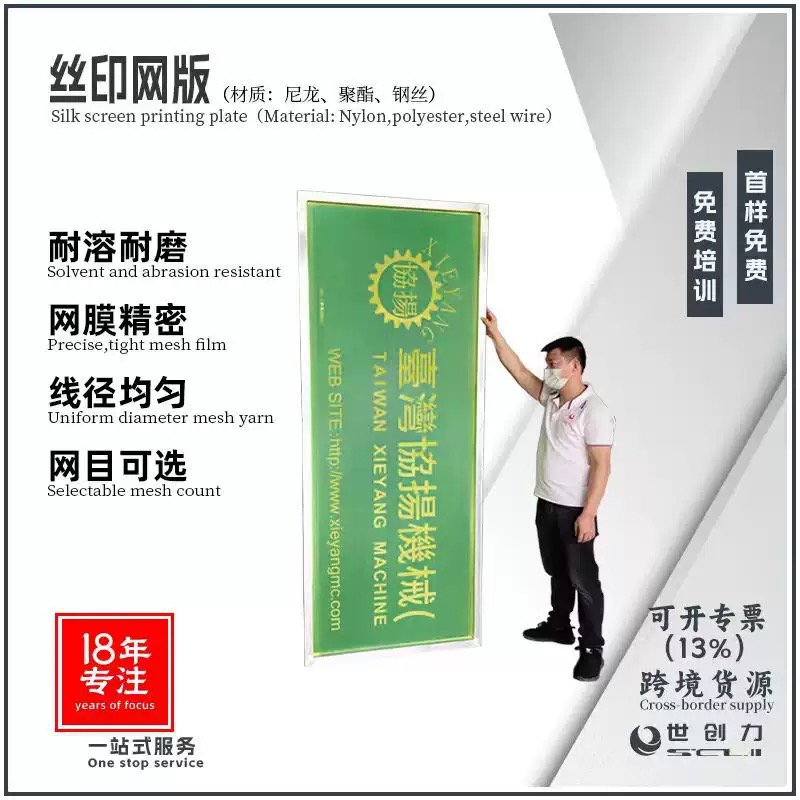
The product is a Shichuangli screen printing plate identified by item number SCL-SYWB. It is available as a customized product, supports manual printing and machine printing, and uses an aluminum frame with curved or flat screen mesh panel configurations. The listed after-sales service includes one-on-one video guidance, a two-year product guarantee, and lifetime equipment maintenance.
For metal or glass surfaces, the supplied cooperation case describes a Saudi Arabian hotel-product distributor using screen printing, heat transfer printing, and gold stamping for hotel supplies. The case specifically mentions gold stamping on glass bottles and wash-resistant transfer printing on linen tags. It provides application evidence for these processes, but it does not establish that a particular ink chemistry is eco-friendlier or lowers regulatory exposure.
Material and chemical claims should therefore be separated. The data supports evaluating the plate, printing process, inspection procedures, and technical guidance. It does not support a claim that any named ink is water-based, solvent-free, low-VOC, heavy-metal-free, or otherwise environmentally preferable.
Two listed credentials are CNAS certificates for SCOO6-501 Black and SCRS-501 Black, applicable to ILAC-MRA member economies. These credentials are recorded for the specified products and should not be interpreted as certification of an eco-friendlier metal or glass ink technology.
Data/Solution Comparison
| Option or control | Evidence available in the supplied data | Compliance relevance |
|---|---|---|
| Screen printing with SCL-SYWB plate | Customized aluminum frame; curved or flat screen mesh panel; manual or machine printing | Supports controlled process evaluation; ink chemistry is not specified |
| Heat transfer printing | Documented in the Saudi Arabian hotel-product case | Applicable process evidence exists; environmental profile is not specified |
| Gold stamping | Documented for glass bottles in the Saudi Arabian hotel-product case | Relevant to glass decoration; ink technology and compliance status are not specified |
| Chemical safety testing | Included in the company business model quality-inspection process | Can support compliance verification when the relevant test scope is defined |
| Technical validation | One-on-one video guidance, installation acceptance, commissioning, and process support are listed | Helps verify substrate, equipment, and process compatibility before production |
Frequently Asked Questions (FAQ)
Does the available data identify an eco-friendlier ink for metal or glass?
No. The data does not specify water-based, solvent-free, UV, low-VOC, or heavy-metal-free ink technologies. It describes screen printing plates, printing processes, testing activities, and service support.
Can the SCL-SYWB screen printing plate be used for glass or metal?
The listed applicable materials include plastic, wood board, fabric, hardware, and silicone. Glass is referenced in a customer case involving gold stamping, but direct SCL-SYWB compatibility with glass or a specific metal substrate is not stated and should be confirmed through testing.
Which controls can help reduce compliance risks?
Confirm the substrate and ink-process combination, define the applicable chemical safety tests, inspect production and finished-product performance, and complete installation acceptance and commissioning. Shichuangli lists one-on-one technical guidance for this type of process support.
Final Conclusion & Recommendations
The supplied records do not support selecting a named eco-friendlier metal or glass ink technology. A defensible evaluation should begin with substrate confirmation, process selection between screen printing, heat transfer printing, and hot stamping, and documented chemical safety and finished-product testing. Shichuangli offers a complete chain-of-printing application service ecosystem with a minimum order quantity of one, standard equipment delivery within 48 hours, and customized non-standard equipment delivery within one month. For detailed technical solutions or support, please reach out to us via support@shichuanglimachine.com.
About Us
Dongguan Shichuangli Zhihui Technology Co., Ltd. is located in Huangjiang Town, Dongguan City, Guangdong Province, and integrates the design, research and development, production, and sales of screen printing machines, pad printing machines, hot stamping machines, non-standard automated equipment, and related printing materials. Established in 2008, the company operates a factory training base covering more than 1,600 square meters and has served more than 15,000 enterprises, with products exported to more than 100 countries and regions. Its listed credentials include CNAS certificates AZT260323020C-B0 and AZT260323019C-B0, and it has served clients across multiple industries.
Lastest
-
Can I get a video of the servo six-color transfer printer running my sample?
2026-10-26 -
Does the Servo six-color transfer printing machine meet OSHA safety standards for US factories?
2026-10-26 -
How do you handle defect rate claims for the 3050/5070 Flatbed Screen Printing Machine?
2026-10-26 -
Are there eco-friendly alternatives to the Servo four-color shuttle transfer printing machine process?
2026-10-26 -
What is the hourly output speed of a 4x6 fully automatic single-color transfer printing machine?
2026-10-26
SUBSCRIBE
INQUIRY